Tensegrity Workshop Series
An archive of the workshop series we’ve been running since 2018.
Previous Workshop
RoboSoft 2025 - Lausanne, Switzerland
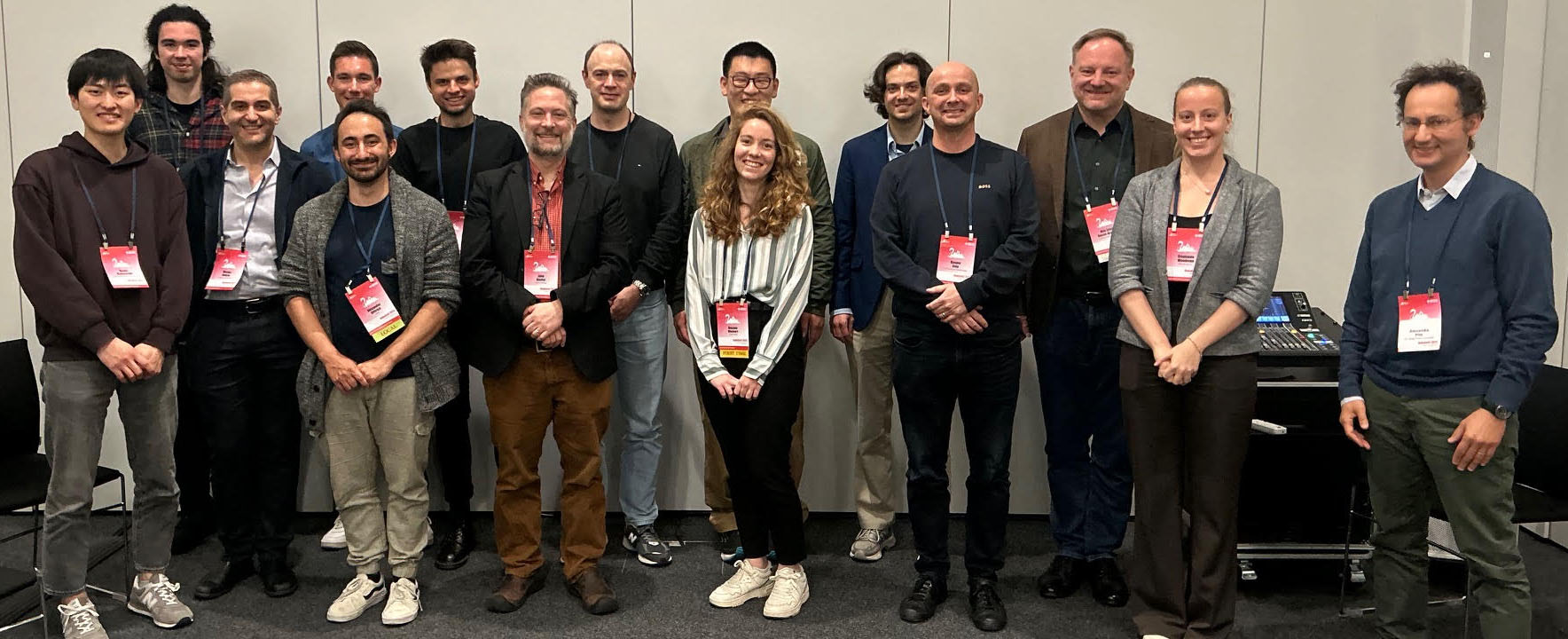
Organizers:
- John Rieffel (Union College) – Chair
- Xiaonan (Sean) Huang (University of Michigan)
- Vishesh Vikas (University of Alabama)
- Will Johnson (Yale University)
- Valter Böhm (OTH Regensburg)
- Kostas Bekris (Rutgers University)
Description
As compliant structures with tunable stiffness, tensegrities are a compelling platform with which to study the spectrum of robotic morphologies, ranging from soft to rigid. This workshop will provide a forum to discuss recent advances and challenges in the field of soft tensegrity robotics. Our ambition for this workshop is to use it as an opportunity to diversify and expand the community of those engaged in tensegrity research. This workshop will provide participants from a wide variety of fields including engineering, computer science, mathematics, and architecture with an opportunity to present and discuss the current state of the art in tensegrity robotic research through invited talks, live robot demonstrations, breakout sessions to explore the Grand Challenges of the field, an interactive panel discussion, and a student-focused poster session.
Tensegrities are relatively simple mechanical systems, consisting of a number of rigid elements (struts) joined at their endpoints by tensile elements (cables or springs), and kept stable through a synergistic interplay of pre-stress forces. Beyond engineering, properties of tensegrity have been demonstrated at all scales of the natural world, ranging from the tendinous network of the human hand to the mechanotransduction of living cells. At every scale, tensegrity structures have an impressive strength-to-weight ratio and demonstrate robustness and stability through deformation. Moreover, tensegrity structures are inherently modular (consisting of only struts and springs). This means that increasingly complex tensegrity structures can be constructed simply by increasing the number of struts and springs. They are simple enough to be baby toys and complex enough to serve as the basis for the next generation of NASA’s planetary rovers.
Tensegrity structures are therefore a compelling and versatile platform with which to explore a wide range of topics and applications relevant to the broader IEEE-RAS community, including biomimetics, bio-inspired robots, soft material robotics, compliant joint/mechanisms, and tendon/wire mechanisms (to name just a few). The goal of this workshop is to provide a showcase for tensegrity researchers to present advances in the state of the art and to discuss ongoing challenges while simultaneously attracting and engaging new participants in the field.
This will be the fifth workshop in a series dating back to RoboSoft 2018 in Livorno, Italy. This year, we are deviating from the traditional workshop format to provide a more engaging forum for participants with the aim of celebrating the interdisciplinary nature of tensegrity research and broadening participation in the field.
Call for Contributions [DEADLINE EXTENDED]
We are calling for participants to contribute poster presentations and live demonstrations at the workshop. We encourage participants to present live demos if possible! Submissions do not need to specifically focus on tensegrity robots, but they should be of interest to the tensegrity robotics community. Those interested should submit a one-page abstract in IEEE conference format using this form. Templates are available for download at the IEEE Template Selector. You may also include a link to supplementary materials (e.g., videos). The submission deadline is Wednesday, April 9, 2025 AoE. All participants will be invited to a future special issue on tensegrity robotics.
Specific topics include (but are not limited to):
- Tensegrity-based soft robots
- Bioinspired tensegrity robots
- Tensegrity Modular Robots
- Multi-scale tensegrity robots
- Biological modeling with tensegrity systems
- Tensegrity models and simulators
- Sensing, control, and actuation of tensegrity robots
- Theory of tensegrity systems
- Applications of tensegrity robots
- Tensegrity structures in biological system
Schedule
(all times UTC+2)
- 09:00 - Opening Remarks
- 09:15 - Invited Talks
- 09:20 - Ryota Kobayashi Stretchable McKibben Muscles and Their Application to Tensegrity Robots
- 09:40 - David Herrmann Compliant tensegrity structures in soft robotics - selected applications
- 10:00 - Xiaonan Huang Towards Autonomous Tensegrity Robots
- 10:20 - Roxane Vimbert Tensegrity to explain the postural balance of birds
- 10:40 - Jan Petrs Tensegrity robotics: Challenges and visions for larger scales and walking robots
- 11:00 - Live Demos + Coffee Break
- 11:30 - Breakout Discussion: Tensegrity Applications
- 13:00 - Lunch
- 14:00 - Scrum share-out from breakout discussion
- 14:15 - Invited Talks
- 14:20 - Patrick Meng Demonstrating an Open-source, Reproducible System for Tensegrity Navigation among Obstacles
- 14:40 - Luyang Zhao Soft Modular Robots: From Modular Tensegrity Structures to Bioinspired Robots
- 15:00 - Lauren Ervin Geometric Static Modeling Framework for Piecewise-Continuous Curved-Link Multi Point-of-Contact Tensegrity Robots
- 15:20 - Poster Session + Coffee Break at 15:30
- 16:00 - Breakout Discussion: Grand Challenges
- 17:00 - Panel Discussion
Direct all correspondence to John Rieffel (rieffelj@union.edu)
RoboSoft 2022 (Virtual)
Edinburg, Scotland, April 4, 2022
Organizers:
- John Rieffel (Union College) – Chair
- Dario Floreano (EPFL)
- Rebecca Kramer-Bottiglio (Yale)
- Valter Böhm (OTH Regensburg)
- Vishesh Vikas (University of Alabama)
Description
Following on the successes of our 2018 and 2019 workshops, the purpose of this workshop is to provide a forum to discuss recent advances and challenges in the field of tensegrity robotics. As compliant structures with tunable stiffness, tensegrities are a compelling platform with which to study the spectrum of robotic morphologies, from soft to rigid. Tensegrities are relatively simple to design and fabricate, and yet they present all the same challenges and pathologies of more conventional robots. Most valuably, they are incredibly modular, requiring few distinct parts and allowing them to scale quite well in complexity. This workshop will provide participants with an opportunity to present and discuss the current state-of-the-art in tensegrity robotic research, through a series of invited talks, a solicited poster session, and an interactive panel discussion.
Tensegrities are relatively simple mechanical systems, consisting of a number of rigid elements (struts) joined at their endpoints by tensile elements (cables or springs), and kept stable through a synergistic interplay of pre-stress forces. Beyond engineering, properties of tensegrity have been demonstrated at all scales of the natural world, ranging from the tendinous network of the human hand to the mechanotransduction of a living cell. At every scale, tensegrity structures have an impressive strength-to-weight ratio, are structurally robust, and stable in the face of deformation. Moreover, tensegrity structures are inherently modular (consisting of only struts and springs). This means that increasingly complex tensegrity structures can be constructed simply by increasing the number of struts and springs. They are simple enough to be baby toys and complex enough to serve as the basis for the next generation of NASA’s planetary rovers. Tensegrity structures are therefore a compelling and versatile platform with which to explore a wide range of topics and applications relevant to the broader IEEE-ROS and ICRA communities, including biomimetics, bio-inspired robots, soft material robotics, cellular and modular robots, compliant joint/mechanism, distributed robot systems, and tendon/wire mechanisms (to name just a few). The goal of this workshop is therefore to provide a showcase for tensegrity researchers to present advances in the state-of-the-art and to discuss ongoing challenges within the field, while simultaneously attracting and engaging new participants in the field.
Specific topics include (but are not limited to):
- Tensegrity-based soft robots
- Bioinspired tensegrity robots
- Tensegrity Modular Robots
- Multi-scale tensegrity robots
- Biological modeling with tensegrity systems
- Tensegrity models and simulators
- Sensing, control, and actuation of tensegrity robots
- Theory of tensegrity systems
- Applications of tensegrity robots
- Tensegrity structures in biological system
Schedule (all times GMT+1)
- 14:00: Opening Remarks (5 minutes)
- 14:00-16:00 Invited Talks: (15 minutes + 5 minutes questions)
- Tensegrity Robots Driven by Thin Pneumatic Artificial Muscles, Ryota Kobayashi (Tokyo Tech)
- Wheeled Tensegrity Modular Robots for Practical Applications, Tianyuan Wang (University of York)
- A System Design Approach for Control of Tensegrity Robots, Raman Goyal (PARC)
- Behavioral Repertoires for Tensegrity Robots, John Rieffel (Union College)
- Collision Resilient Bio-inspired Tensegrity Drone, Omar Aloui (EPFL)
- 16:00 – 17:00pm Poster Spotlight Talks/Poster Session: ( 3-minutes each)
- Compliant grippers based on multistable tensegrity structures, Glaser, J.; Langenscheidt, R.; Boehm, V. (OTH Regensburg)
- Multimodal mobile robot based on a multistable tensegrity structure, Schorr, P.; Boehm, V. (OTH Regensburg)
- A soft, stiffness-controllable joint using antagonistic actuation principles, Wenlong Gaozhang (UCL)
- 17:00 Panel Discussion:An open-ended interactive panel discussion of the upcoming ”grand challenges” of tensegrity robotics research.
POSTER GUIDELINES:
Please respect A0 poster size in portrait orientation (841x1189mm) for your poster. Paper Details:
All participants will be invited to a future Journal Special Issue on tensegrity robotics.
Submissions can be sent to the workshop chair, rieffelj@union.edu.
Direct all correspondence to John Rieffel (rieffelj@union.edu)